

Logo Clipping Campaigns. Your Brand, Everywhere.
Logo clipping campaigns put your logo inside creator-posted short-form videos across TikTok, Instagram Reels and YouTube Shorts, so the brand travels with the content instead of interrupting it. Clippers follow approved placement rules, Clipping Culture reviews every submission and reports the views that count, and you pay for verified views only. Campaigns start at $15,000.
10B+ views generated for brands.
531K+
Clippers in the network
147
Published case studies


Monkey Tilt
Hostage Tape
Superbetin
LinkMe
TheClubHouse
WOLFpak
Higgsfield AI

Fanatics
MLB
Trimz AI
Jennah Organic
Dhar Mann
Keemokazi
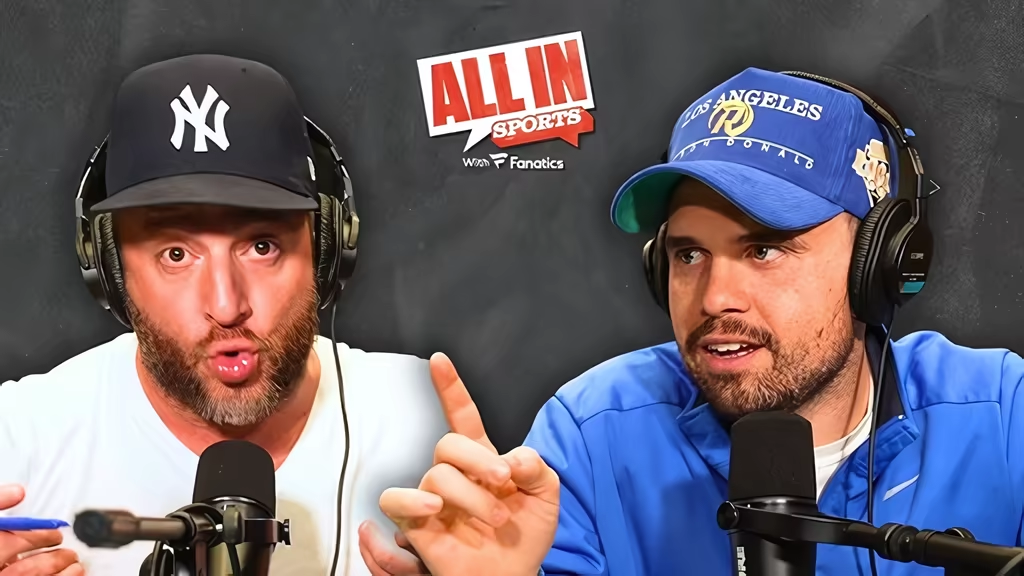
All In Sports Podcast
What is a logo clipping campaign?
A logo clipping campaign is a creator-led awareness program where the brief stays simple: your logo appears in native short-form posts, and performance is measured on verified views. Placement and distribution are managed by our clipping agency.
Clippers post short-form videos with your logo placed visibly in the content. They pick the format (reaction clips, edits, memes, trending sounds) so every video feels native to the platform.
Views generated across campaigns
Clippers in the network
Published case studies
Logo promotion for brands people should recognize
Logo campaigns suit brands whose logo reads on a phone screen and who want repeated exposure more than a detailed pitch.
Casinos and gaming
Continuous visibility across short-form feeds.
Casinos and gaming
Casinos, betting platforms, and gaming companies use logo campaigns for a steady presence in short-form feeds. Monkey Tilt’s logo campaign reached 53M+ views from 2,008 clips.
- Casinos
- Betting platforms
- Gaming
- Always-on visibility
Apps and software
Awareness before or alongside paid acquisition.
Apps and software
Apps and SaaS products run logo campaigns to build brand awareness before or alongside paid acquisition. LinkMe’s logo campaign reached 3.6M+ views from 469 clips.
- Apps
- SaaS
- Launch awareness
- Paid-media companion
Consumer brands
Logo recognition at scale.
Consumer brands
Consumer brands with a strong visual identity use logo placements for recognition at scale, as long as the mark reads clearly on a phone screen. WOLFpak’s campaign through the same network reached 6.3M+ views from 1,235 clips.
- Strong visual identity
- Mobile-legible logo
- Repeated exposure
- Brand recall
Sponsors and partners
Placement that outlasts event day.
Sponsors and partners
Companies running sponsorships or partnerships use logo campaigns to keep the placement visible beyond event-day exposure.
- Sponsorships
- Partnerships
- Event follow-through
- Sustained visibility
Every placement is tracked on a live dashboard
Logo campaigns run on Whop Content Rewards dashboards, like every Clipping Culture campaign. Views are tracked by platform and by post, and only placements that pass review count toward the target.
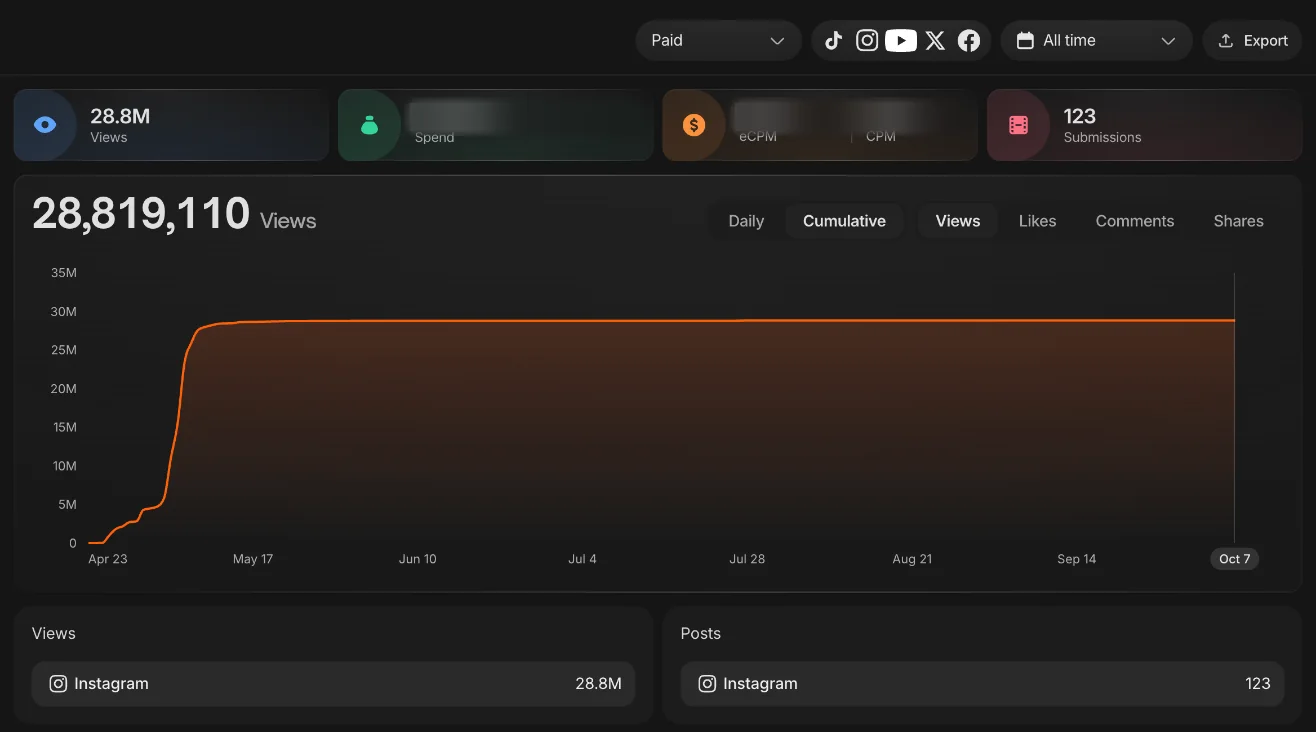
TurkBet, logo campaign
TurkBet’s logo campaign reached 28.8M views from 123 Instagram posts since April 23, with likes, comments and shares tracked for every approved post.
- Views, likes, comments and shares in one place
- Platform filters for TikTok, Instagram and YouTube
- Only approved placements count toward the target
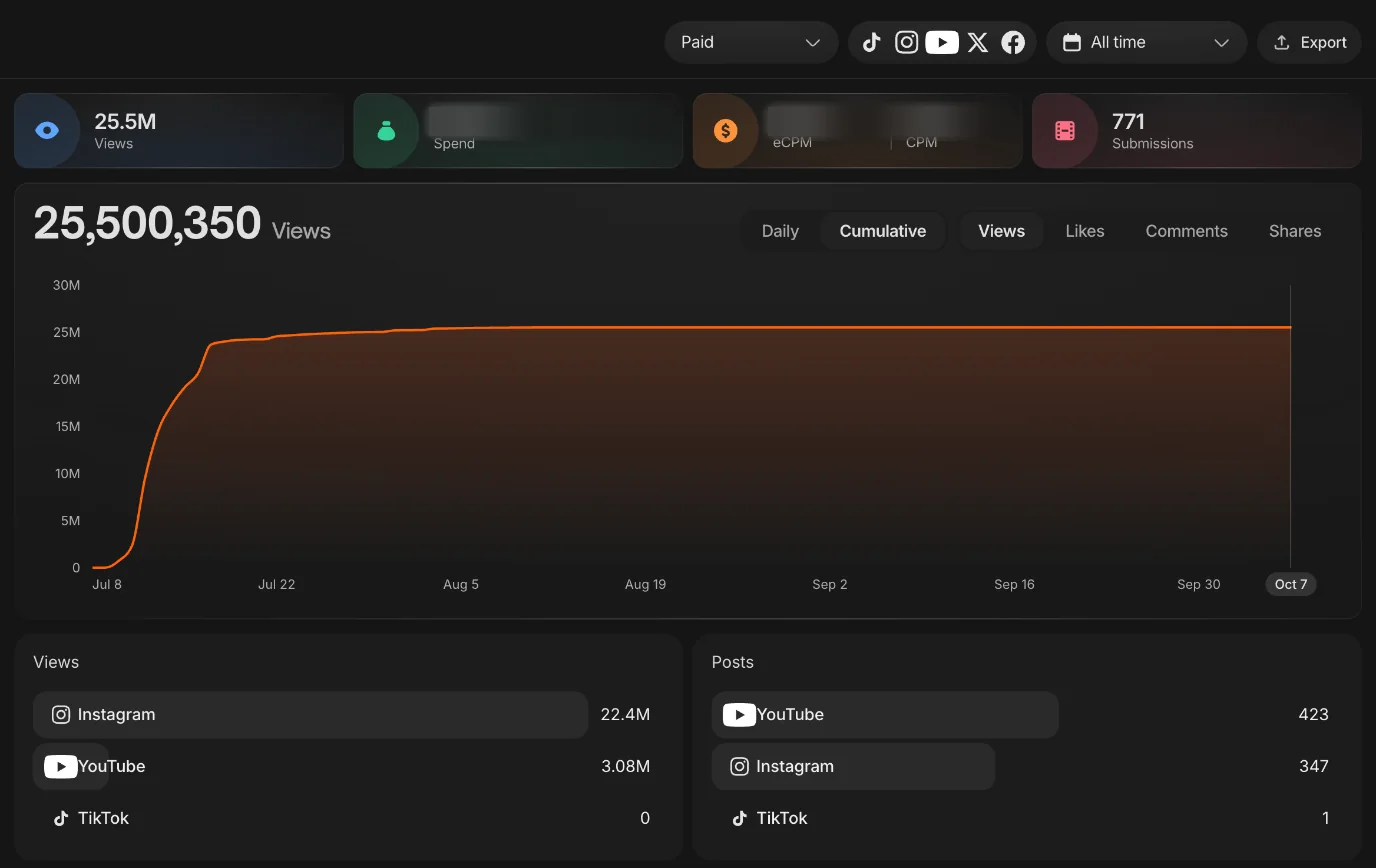
Yeet Casino, logo campaign
25.5M views from 771 posts on YouTube, Instagram and TikTok since July 8.
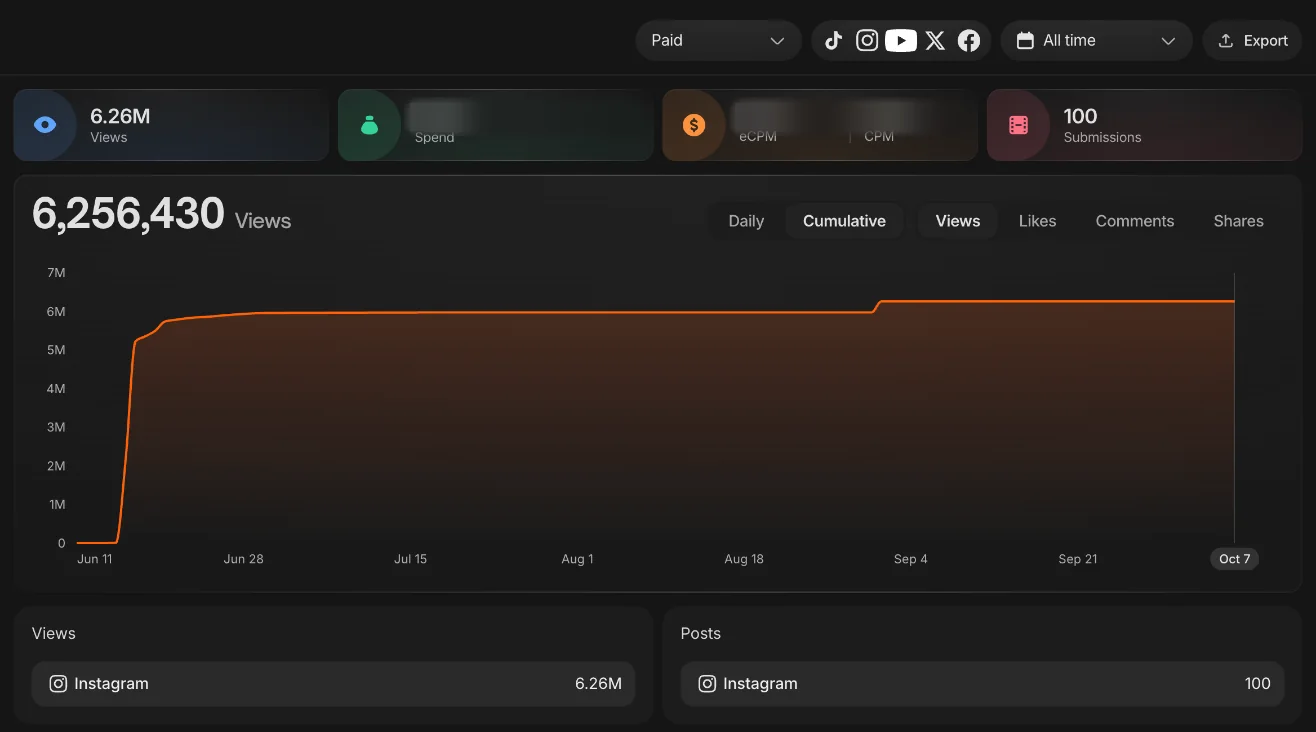
Poker Patio, gameplay highlights
6.3M views from 100 Instagram posts since June 11.
What a logo placement looks like in a real clip
The clipper brings the content and the logo rides along. Viewers watch a football debate or a poker hand they chose, and the brand mark sits on screen the whole time.
- The logo stays on screen, clear of captions
- Content the viewer chose, not an ad slot
- Placement checked before views count
Logo campaign
TurkBet, football commentary, 1.44M views on Instagram
iGaming campaign
Poker Patio, “Bro went all in”, 545K views on Instagram
Logo campaigns and other brand results.
Monkey Tilt, Superbetin and LinkMe ran logo campaigns; TheClubHouse Casino, Fanatics and WOLFpak ran campaigns through the same clipper network. Each record shows the brand, the clips submitted and the views generated.
One logo brief. Thousands of creator placements.
Logo campaigns follow a streamlined three-step process. A simple logo requirement is easy for participating clippers to understand while leaving room for varied creative styles and formats.

Before launch
Logo brief and placement guidelines

In-feed
Clipper-created logo posts

Verified delivery
Review and report
The rules a logo clip is checked against.
A logo brief is short, which is why it scales. These are the three things every one fixes before launch, and the reasons a clip fails review.
01
Where the logo goes.
The brief fixes the placement, so the mark is never missing, too small, or covered by captions or the platform’s own buttons.
- Fixed placement
- Readable on a phone
- Clear of captions and buttons
02
What is off-limits.
Approved content categories and an off-limits list are part of the brief, so a clip that drifts outside them fails review before its views count.
- Approved categories
- Off-limits list
- Brand safety
03
How the post is disclosed.
Clippers are paid to post, so every brief says exactly how to disclose it, such as #ad. Reposts, duplicates and clips on unlisted platforms are rejected too.
- Required disclosure
- Listed platforms only
- No reposts or duplicates
How logo clipping campaigns work
Clippers post short-form videos with your logo placed visibly in the content. They pick the format (reaction clips, edits, memes, trending sounds) so every video feels native to the platform.
Because the brief is lightweight, clippers from a network of hundreds of thousands can take part at once, generating volume that a single brand account could never match.
How logo campaigns differ from traditional brand awareness
Display ads put your logo in front of passive audiences. Logo clipping campaigns put it inside content people choose to watch. Attention is earned, not rented.
Monkey Tilt is the largest published logo campaign: 53M+ views from 2,008 clips.
What logo campaign economics look like
You pay for verified views, not placements. Verified views typically cost about $1.50 per 1,000. For comparison, ads on Meta and YouTube Shorts run about $6–$14 per 1,000 impressions according to the Jonas Agency’s 2026 paid social benchmarks. That figure is not our data, and an impression is not a verified view.
Key takeaways
- Logo placement is the simplest brief format, so it scales faster than complex campaign requirements.
- Viewers see your logo inside content they chose to watch, not in an interruptive ad slot.
- Verified views typically cost about $1.50 per 1,000, and only approved posts count.
- The model can be adapted across casinos, apps, products, and other brands with a clear visual identity.
How a logo campaign runs, step by step
01. Logo brief and placement guidelines
The campaign brief records logo requirements, placement rules, and content boundaries so qualifying submissions stay within the guidelines while clippers retain creative freedom.
- Logo file formats, minimum size, and positioning rules
- Approved content categories and platform targets
- Brand safety boundaries: what content is off-limits
02. Clipper-created logo posts
The campaign becomes available across a 532K+ clipper network. Participating clippers publish in their own styles with the required logo placement, creating varied formats and audience angles.
- Independent creative interpretations within one clear logo rule
- Multi-platform distribution across TikTok, Reels, and YouTube Shorts
- A review of every post ensures logo visibility and compliance
03. Review and report
Submissions are reviewed against the logo-placement guidelines, we verify which views count, and delivery is reported against the target.
- A review of every post against placement rules
- Eligible views verified
- Delivery recorded against the target
Why logo clips get rejected
Every brief sets where the logo goes and what is off-limits, and each post is checked against it before its views count. These are the main reasons a logo clip fails review:
- The logo is missing, too small, or covered by captions or the platform’s own buttons.
- The disclosure the brief asks for, such as #ad, is missing.
- The content falls outside the approved categories or touches the off-limits list.
- The clip is a repost or duplicate of another clipper’s video.
- It was posted on a platform the brief does not list.
Disclosure matters because clippers are paid to post, so every brief tells clippers exactly how to disclose it. Our logo clipping campaigns guide covers the rules in more detail.
Why short-form logo visibility matters
Short-form video is where attention lives. Logo placement in organic creator content reaches audiences that ad blockers, skip buttons, and banner blindness cannot touch.
Nine-in-ten U.S. teens use YouTube.
Pew Research Center reports that roughly nine-in-ten U.S. teens use YouTube, making it the most widely used platform in that age group.
200B+ daily YouTube Shorts views.
YouTube said in February 2026 that Shorts averages over 200 billion daily views (YouTube Blog), a massive surface for logo visibility.
Meta is consolidating video around Reels.
Meta is consolidating its video ecosystem around Reels, expanding the surface area for short-form logo placements (Social Media Today).
Where logo campaigns are not the right fit.
- Products that require detailed explanation: logo placement alone will not educate prospects.
- Brands without a finalized visual identity or logo that translates well to mobile screens.
- Teams expecting direct response conversions from logo exposure alone without a retargeting strategy.
- One-time event promotion with no plan for sustained visibility after the campaign.
If your product needs explaining, a standard clipping campaign built from approved long-form footage gives clippers more to work with than a logo alone.
How much does a logo clipping campaign cost?
Pricing is based solely on the number of verified views you want. Managed logo campaigns start at a $15,000 minimum spend. Verified views typically cost about $1.50 per 1,000, and managed campaigns start at $15,000. Most campaigns are scoped to a custom view target, so the budget rows on the pricing page are for illustration.
What to check in logo campaign proof
Good logo campaign proof shows total views, the number of submissions, the cost per 1,000 verified views, and whether the campaign moved brand search or platform sign-ups.
- Verify total views and submission count against budget spent.
- Check the cost per 1,000 verified views against the campaign budget.
- Look for evidence of brand search lift or platform signups driven by logo visibility.
- Confirm the campaign ran across multiple platforms, not just one.
Explore our clipping and editing services or get in touch to plan your first campaign.
Related services for brand visibility
Most brands pair logo campaigns with platform programs or other campaign types. Explore the adjacent services before scoping your launch.
Campaign types
- Clipping campaigns overview
- Music clipping campaigns
- Podcast clipping campaigns
- Public figure campaigns
Platforms and tools
Logo clipping campaigns vs. ads and freelancers.
Typical differences between a managed logo clipping campaign, in-house paid media, and freelancer content production.
| Decision | In-house ads & displayYour team buys the media and runs the ads. | Freelancer editorsEditors deliver files for your team to post. | Managed logo campaignCreator distribution with verified views. |
|---|---|---|---|
| Cost model | About $6–$14 per 1,000 impressions on Meta and YouTube Shorts (Jonas Agency, 2026). An impression is not a verified view. | Per-video editing fees, plus separate distribution spend. | Priced on the target verified-view volume; verified views typically cost about $1.50 per 1,000. |
| Creative throughput | Internal bandwidth limits how many variants get made. | Output grows only as editing spend grows. | Hundreds to thousands of logo-placement videos; Monkey Tilt’s campaign ran 2,008 clips. |
| Audience perception | Clearly ad-labeled and easier for viewers to ignore. | Creative may feel stronger, but distribution still depends on ads or owned channels. | Posted from creator accounts, so the content feels more native in-feed. |
| Distribution ownership | Your team manages media buying and reach directly. | You receive assets, then handle publishing or paid distribution yourself. | Distribution is built in through 532K+ clippers. |
| Scaling behavior | Reach grows with ad budget and stops when spend stops. | More volume means more editing cost and more separate distribution work. | A larger target verified-view volume increases the campaign budget. |

Logo clipping campaigns combine the visibility of paid media with the engagement of creator-led content.
Trusted by brands, studios and labels
Logos we are cleared to show, with the published result wherever a case study exists.





Rated 4.7 by the clippers who carry your logo.
A logo campaign is only as visible as the clippers who keep posting it. These reviews are quoted word for word from Clipping Culture’s public Whop page, alongside what Vogue reported.
Kevziiii
Clipper, Whop review
Mods are fast like flash
Vogue
Do Fashion Brands Need a Clipping Strategy? · Sep 22, 2026
“Most large gaming publishers and record labels now run clipping campaigns as a standard part of their content strategy,” says Evan Stanfield, founder of Clipping Culture.
yousef saad
Clipper, Whop review
I've had a great experience with this community so far. The content is helpful, the members are supportive, and I've learned a lot in a short amount of time. Everything is well organized, and the value provided is definitely worth it.
2,300+
2,300+ reviews
4.7/5
Whop rating
These reviews come from the clippers who post campaigns and are paid through Whop, so they rate the part of a campaign buyers never see: briefs, moderation and payouts.
Clippers who are paid fairly and answered quickly keep posting, and that is what keeps delivery consistent from the first week of a campaign to the last.
Oddist
Clipper, Whop review
Great clipping community! As a beginner, I felt welcomed right away. The mods are friendly, helpful, and very understanding. It's a great place to learn, improve your skills, and find opportunities.
Gaby Fatsin
Clipper, Whop review
This is a campaign that pays for real, fast, legit campaigns
What brands ask before launching a logo campaign.
Straight answers on cost, creative rules, platforms, expected results, and how the model differs from display advertising.
What is a logo clipping campaign?
How much does a logo clipping campaign cost?
What results can I expect from a logo campaign?
Do clippers need to follow specific creative rules?
Which platforms do logo campaigns run on?
How is a logo campaign different from display advertising?
Is a logo promotion campaign the same as a logo clipping campaign?
Do I need long-form footage to run a logo campaign?
I am a clipper. How do I join a logo campaign?
Your logo should live in the feeds your customers actually scroll.
Bring the brand kit and approved footage. We will confirm the placement guidelines, platforms, and number of verified views you want before you commit. 20-minute intro. No prep deck required.